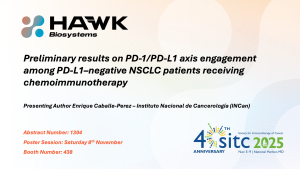
HAWK Biosystems is proud to announce that Dr. Enrique Caballé-Pérez, from the Instituto Nacional de Cancerología (INCan, Mexico), will present a poster at the SITC 2025 Annual Meeting featuring outstanding preliminary clinical results obtained using the company’s proprietary QF-Pro® technology.
For the first time, direct quantification of PD-1/PD-L1 engagement measured by QF-Pro® has shown predictive value even in PD-L1–negative (< 1 %) non-small cell lung cancer (NSCLC) patients — a population traditionally considered non-eligible for immune-checkpoint blockade therapies.
Currently, approximately 40 – 45 % of NSCLC patients are classified as PD-L1 negative using standard immunohistochemistry (IHC), leaving clinicians without a reliable biomarker to guide therapeutic decision-making.
Remarkably, PD-L1-negative patients exhibiting high PD-1/PD-L1 engagement measured by QF-Pro® demonstrated significantly improved responses and prolonged progression-free survival following chemo-immunotherapy.
These findings provide the first functional evidence that checkpoint engagement itself — rather than PD-L1 expression levels — can predict clinical benefit, suggesting a paradigm shift in how patients are selected for immunotherapy
Beyond expression: a functional view of immune checkpoint biology
Traditional IHC assays measure bulk PD-L1 expression across tumor cells, providing an indirect and static snapshot of potential immune-checkpoint activity. In contrast, QF-Pro® directly quantifies the physical interaction between PD-1 and PD-L1 receptors within intact tissue, identifying where and when immunosuppression is functionally taking place — even at very low expression levels or in localized tumor–immune niches.
By measuring molecular interactions at sub-10 nm resolution, QF-Pro® detects true receptor–ligand engagement that drives immune evasion. These critical events are completely invisible to conventional staining methods.
Unlike qualitative proximity assays such as PLA (Proximity Ligation Assay), which only infer spatial closeness, QF-Pro® provides a direct, quantitative, and reproducible measurement of functional molecular binding in FFPE clinical tissue, with unmatched levels of sensitivity and specificity.
Seeing below the pixel: the power of FLIM-FRET
This unprecedented precision stems from QF-Pro®’s FLIM–FRET (Fluorescence Lifetime Imaging – Förster Resonance Energy Transfer) enhanced technology.
While conventional fluorescence imaging is limited by the optical size of each pixel (~ 200 nm), FRET operates at the molecular scale (< 10 nm), detecting non-radiative energy transfer between two fluorophores only when they are in direct physical proximity.
In practice, this means QF-Pro® “sees below the pixel” — revealing molecular interactions occurring hundreds of times smaller than the limits of visible resolution, and quantifying them with high reproducibility.
This nanometer-scale readout enables researchers and clinicians to differentiate true functional checkpoint engagement from mere co-localization, providing the first quantitative functional biomarker of immune interaction in patient tissue.
Toward clinical translation and IVDR compliance
HAWK Biosystems is currently collaborating with leading clinical institutions worldwide to expand validation of QF-Pro® and to establish its clinical utility across multiple tumor types.
These collaborations aim to bring the assay into full IVDR (In Vitro Diagnostic Regulation) compliance — making it accessible to hospitals, pathology laboratories, and pharmaceutical partners.
The company’s mission is clear: to equip oncologists with a truly functional diagnostic tool capable of guiding therapy decisions and improving outcomes for NSCLC patients, particularly those left unstratified by current PD-L1 IHC testing.
About QF-Pro®
QF-Pro® is HAWK Biosystems’ proprietary FLIM-FRET assay designed for the quantitative measurement of protein–protein interactions directly in FFPE tissue.
It combines high-resolution fluorescence lifetime imaging with robust analytical quantification to generate functional interaction maps at sub-cellular resolution.
QF-Pro® enables clinicians and researchers to move beyond expression-based biomarkers and toward mechanistic, predictive diagnostics in immuno-oncology.