
QF-Pro® is a clinically-ready in situ interactomics approach that precisely quantifies functional protein states in fixed cells and FFPE tissue
This provides a functional readout within the native tissue microenvironment, the kind of information that expression-based and descriptive spatial assays are not designed to capture.
QF-Pro® technology’s innovative principle
QF-Pro® is based on an enhanced FRET-FLIM approach. It quantifies energy transfer through changes in fluorescence lifetime. Unlike intensity, lifetime is an intrinsic photophysical property independent of staining variability, signal saturation, tissue autofluorescence, fluorophore concentration, and imaging conditions. It provides a spectroscopic readout while preserving tissue architecture and cellular context.
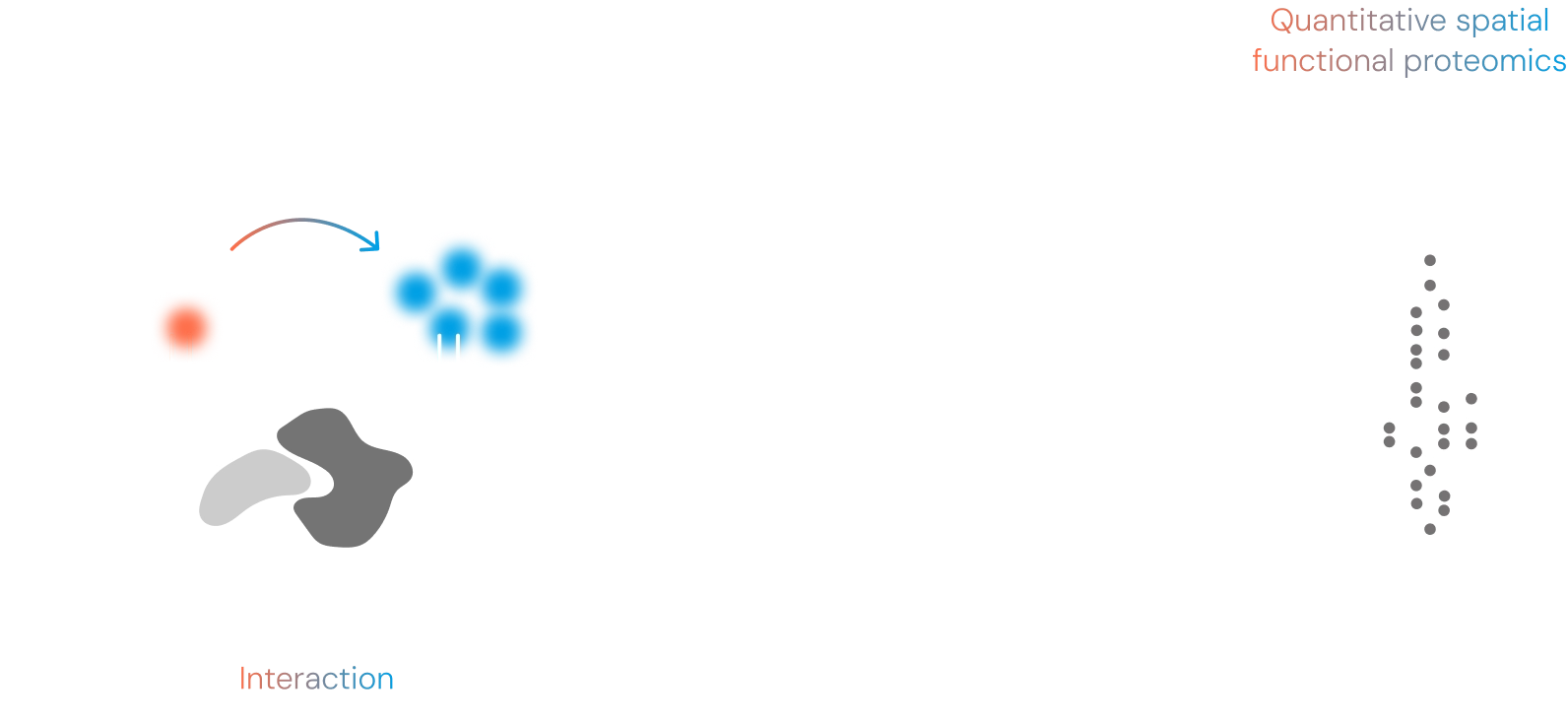
As a result, QF-Pro® delivers standardisable, reproducible quantitative readouts that can be reliably compared across conditions, cohorts, and regions of interest. This is essential for mechanistic research, where robust quantitative data is essential to study functional biology, and for translational and clinical applications, where standardised biomarkers are critical for a successful companion and clinical diagnostic development.
Conventional approaches fall short of
capturing functional protein states
High-plex omics platforms are transforming biomarker discovery - but discovery candidates still need a quantitative, standardisable readout to reach the clinic. QF-Pro® is that bridge.
What it measures
Quantification
Dynamic range
Specificity
PPI / PTM detection
IVD / CDx readiness
IF / IHC
Protein
expression
Semi-quantitative
(Intensity)
Low; saturates at
high expression
Low; antibody
dependent
No; co-localization
(~100 nm)
Established;
intensity-based
PLA
Protein proximity
(~40 nm)
Spot counts
(Intensity)
Low; amplification variable
+ signal saturation
Low; risk of
false-positive
Partial;
~40 nm
Low; not standardised
for CDx
QF-Pro®
Protein engagement
(1–10 nm)
Lifetime
(% FRET – QF-Pro® Score)
High; concentration-independent, spectroscopic by nature
High; 2 site assay
+ lifetime readouts
Yes; both fully
(1-10nm FRET range)
High; quantitative
readout, standardisable
Conventional approaches fall short of capturing functional protein states
Conventional approaches fall short of
capturing functional protein states
IF / IHC
What it measures
Protein
expression
Quantification
Semi-quantitative
(Intensity)
Dynamic range
Low; saturates at
high expression
Specificity
Low; antibody
dependent
PPI / PTM detection
No; co-localization
(~100 nm)
IVD / CDx readiness
Established;
intensity-based
PLA
What it measures
Protein proximity
(~40 nm)
Quantification
Spot counts
(Intensity)
Dynamic range
Low; amplification variable
+ signal saturation
Specificity
Low; risk of
false-positive
PPI / PTM detection
Partial;
~40 nm
IVD / CDx readiness
Low; not standardised
for CDx
QF-Pro®
What it measures
Protein engagement
(1–10 nm)
Quantification
Lifetime
(% FRET – QF-Pro® Score)
Dynamic range
High; concentration-independent, spectroscopic by nature
Specificity
High; 2 site assay
+ lifetime readouts
PPI / PTM detection
Yes; both fully
(1-10nm FRET range)
IVD / CDx readiness
High; quantitative
readout, standardisable
How to onboard QF-Pro®
QF-Pro® integrates seamlessly into standard anatomical pathology workflows, supporting FFPE tissue sections, fixed murine models, and cell preparations. Clients can access it either through HAWK's analysis services, submitting samples for QF-Pro® quantification, or by implementing QF-Pro® Technology directly in their own laboratory.
QF-Pro® Services
QF-Pro® Services give you access to functional quantitative outputs via our central laboratory. Send your samples and we will perform the assays and prepare the report. This model is commonly used to accelerate early translational datasets, generate pilot evidence, or de-risk assay design before committing to platform deployment.
Validated assays
For projects aligned with established assay configurations, we move directly into study execution in fixed cell models and/or FFPE tissue.
Proof of Concept (PoC)
When your targets have not yet been configured for QF-Pro®, we offer a structured PoC to establish feasibility and optimise the assay before scaling.
QF-Pro® Platform
QF-Pro® is a fully integrated system installed in your laboratory, designed for repeated studies and long-term functional biomarker programmes.
FFPE sectioning and slide preparation
Selected primary
antibodies
+ QF-Pro® Reagent Kit
Multi-ROI capture
across selected
regions with Violet 3.0
QF-Pro® Software includes
quantitative functional readouts and images
QF-Pro® Reagent Kit
01 - QF-Pro® Reagent Kit
One kit, any biomarker. Biomarker-agnostic reagent components for QF-Pro® assays in fixed cells and FFPE tissue. Compatible with standard mouse-rabbit primary antibody pairs selected by the user.
Violet 3.0 Hardware
02 - Violet 3.0 Hardware
A compact, purpose-built FLIM acquisition system for fast, high-quality QF-Pro® data generation. Supports multi-ROI acquisition to capture tissue heterogeneity and robust statistical outputs.
QF-Pro® Software
03 - QF-Pro® Software
End-to-end software for guided acquisition, quantitative analysis, and reporting. Generates standardisable QF-Pro® Scores and annotated image outputs, minimising operator-dependent interpretation.
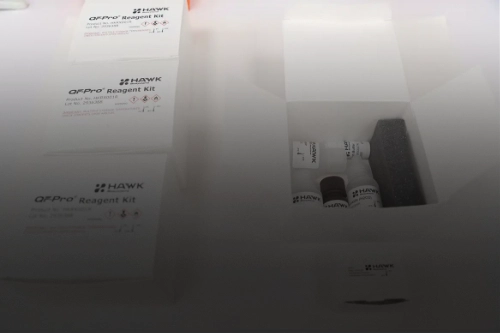
QF-Pro® Reagent Kit
One kit, any biomarker. Biomarker-agnostic reagent components for QF-Pro® assays in fixed cells and FFPE tissue. Compatible with standard mouse-rabbit primary antibody pairs selected by the user.
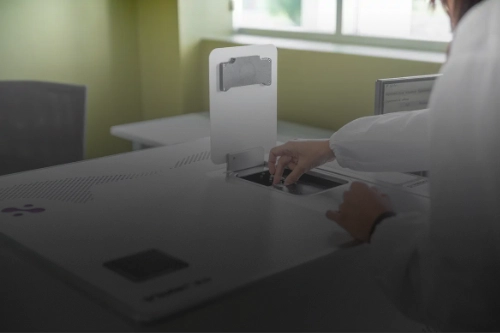
Violet 3.0 Hardware
A compact, purpose-built FLIM acquisition system for fast, high-quality QF-Pro® data generation. Supports multi-ROI acquisition to capture tissue heterogeneity and robust statistical outputs.
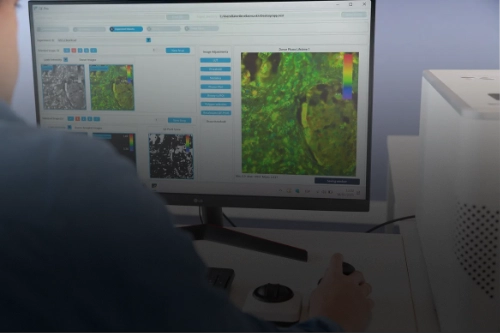
QF-Pro® Software
End-to-end software for guided acquisition, quantitative analysis, and reporting. Generates standardisable QF-Pro® Scores and annotated image outputs, minimising operator-dependent interpretation.
Already have a FLIM system? QF-Pro® Reagent Kits and Software are compatible with a range of existing time-domain and frequency-domain platforms. Apply QF-Pro® without replacing your current instrumentation.
quantify protein function in situ